
What Is an ETF?
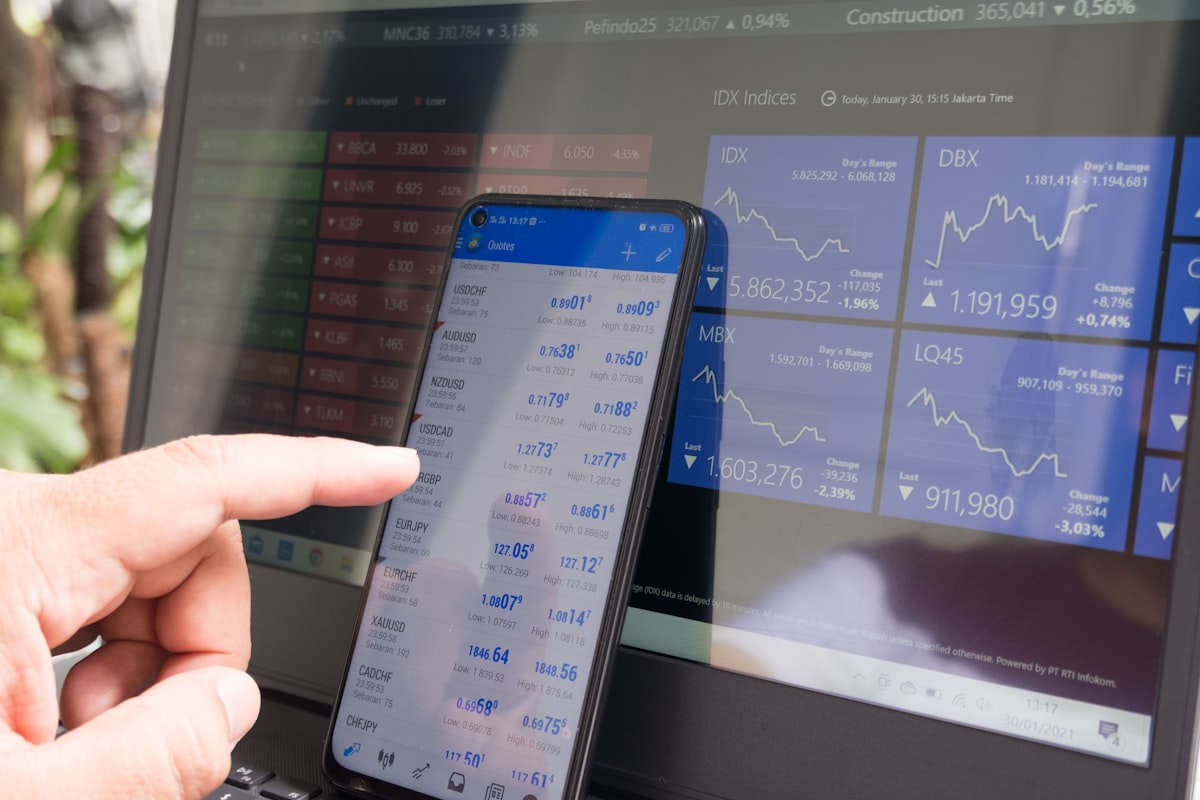
ETF is an abbreviation for Exchange Traded Fund - a fund traded on the stock exchange. Simply put: An ETF is a basket of many stocks or bonds that you can buy as a single asset.
Example
You want to buy shares in large American companies. If I bought them individually, I would need thousands of Kč for Apple, Google, Microsoft... But with an ETF you buy one share that holds all of them.
For example, the ETF "iShares Core S&P 500" holds shares of all 500 largest US companies.
Shares vs. ETFs, What Is the Difference?

| Aspect | Promotion | ETF |
|---|---|---|
| What is it | Share of one specific company | A basket of many stocks or bonds |
| Risk | Higher: the company may go bankrupt. | Lower: diversification |
| Management | You decide which one to buy yourself. | The fund manager selects on your behalf |
| Fees | Only a transaction fee | Annual fund fee (0.1-0.5%) |
| Suitability | Experienced investors | Ideal for beginners |
| Time to choose | Much more. You must research companies | Minimum: just choose a fund |
Recommendations for beginners: Start with ETFs. They are simpler and safer.
How to Buy ETFs in the Czech Republic
Step 1: Choose Your Broker
A broker is an intermediary that connects you to the exchange. In the Czech Republic, your options are:
- Czech banks - ČSOB, Komerční banka, Raiffeisenbank (straightforward but with higher fees)
- Online brokers - Interactive Brokers (IBKR), XTB (lower fees, more products)
- Business platforms - eToro, Plus500 (simplest for beginners, but higher risk)
I recommend Interactive Brokers (ibkr.com): lower fees, quality platform, suitable for the Czech Republic.
Step 2: Open an Account
Register online. It takes 10-20 minutes. You will need:
- Proof of identity
- Proof of address (or a bank statement)
- Bank details for deposits/withdrawals
Step 3: Enter Funds
Transfer funds from your Czech bank account. This typically takes 1-3 working days.
Step 4: Buy an ETF
Register on the Začni Investovat platform, enter the ETF name (e.g., "VANGUARD S&P 500") and state how many shares you wish to purchase. Confirm, done!
Recommended ETFs for Beginners
If you are looking for simple and diversified funds, here are several popular ones:
Equity ETFs (Long-Term Growth)
- Vanguard S&P 500 ETF (VOO) - 500 largest American companies, very popular
- iShares Global Tech ETF (ICLN) - global technology companies
- SPDR Emerging Markets (GEM) - developing markets (Asia, Latin America)
- Vanguard FTSE Developed Europe (VE) - European shares
Mixed ETFs (Equities + Bonds)
- iShares Global All-Cap UCITS ETF (EUNL) - 60% shares, 40% bonds
- Vanguard FTSE All-World ETF (VWRL) - global diversification with lower risk
Tip: Start with one ETF on the S&P 500 (simplest option). Later, you can buy additional ETFs for other regions.
Long-Term Stock Returns
Historically, over the long term (20+ years), shares have yielded an average return of 7-10% annually. This varies by region and season.
Historical Returns (Last 20 Years)
- USA (S&P 500) - approx. 9-10% annually
- Europe - approx. 6-7% per year
- Developing markets - approx. 8-9% annually (higher volatility)
Important: Past performance is not a guarantee of future results. However, historically, long-term stock investments are how wealth grows.
The Compound Interest Effect (Compounding)
When you reinvest dividends and returns, your money grows exponentially:
- 10 000 Kč per year: 11 000 Kč (10%)
- 10 years: 26 000 Kč
- 20 years: 67 000 Kč
- 30 years: 174 000 Kč
That is the power of long-term investment!
Risks of ETFs and Shares
Market Risk
Share prices fluctuate. For example, during COVID-19 (March 2020), the S&P 500 fell by 35% in a month. Those who sold in panic lost out. Those who waited received a profit by the end of the year.
Inflation Risk
If you hold cash, inflation is eating away at its value. Stocks provide good protection.
Concentration of Risk
If you buy only one or two shares, you face high risk. With an ETF, you get automatic diversification.
How to avoid problems: Invest for the long term, don't panic, use ETFs.
Practical Steps
- Choose a broker. I recommend Interactive Brokers for lower fees.
- Open an account. Register and verify your identity.
- Put your money in. Start with an amount you can afford to lose (without panic).
- Buy one ETF to test it out. E.g. Vanguard S&P 500 - 5-10 stocks.
- Later, buy regularly. The same amount every month: Dollar Cost Averaging.
Summary
- ETFs are baskets of stocks or bonds: ideal for beginners.
- Stocks carry higher risk but offer higher long-term returns.
- Historically, actions yield 7-10% annually.
- In the Czech Republic, purchase via a broker (IBKR, a bank, etc.).
- Start with one simple ETF.
- Invest for the long term: do not panic over fluctuations.